Onions make food taste like home — but their tear-inducing powers can turn a quick prep into a dramatic scene. The good news: you can beat the waterworks with simple techniques and a little practice. No gimmicks, no weird gadgets—just clear steps that actually work.

Why Onions Make You Cry (Quick and Simple)
Before we jump into hacks, a short explanation helps make the tricks make sense.
- When you cut an onion, you break cells that release an enzyme called alliinase.
- That enzyme reacts and forms a volatile gas (syn-propanethial-S-oxide).
- The gas reaches your eyes, reacts with the moisture there, and forms mild sulfuric acid — cue the sting and tears.
So — reduce the gas, block it from reaching your eyes, or neutralize it. That’s the strategy behind every useful tip.
Prep & Tools That Help Every Time
Small changes before you cut can lower the chance of crying a lot.
- Use a very sharp knife — it makes cleaner cuts and breaks fewer cells.
- Chill the onion in the fridge (or freezer for 10–15 minutes) before cutting to slow the reaction.
- Work near running water or with a small bowl of water nearby (optional).
- Keep a damp paper towel or a lens-cleaning cloth for quick wipes.
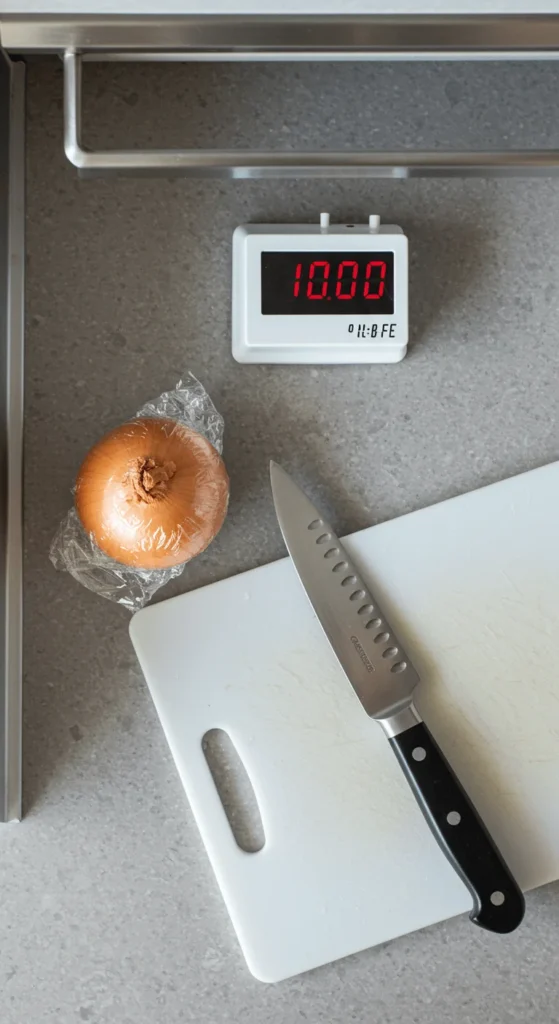
Step-by-Step: A Calm, Tear-Free Chop
1) Peel smart
- Trim the stem (not the root end yet).
- Slice off the top, cut onion in half through the root, then peel skin away.
- Leaving the root intact helps hold layers together and reduces gas release.
2) Lay it flat
- Place the half onion flat-side down. This keeps it stable and safer to cut.
3) Make even vertical cuts
- With root end facing away, slice vertically toward, but not through, the root. Keep cuts even for uniform dice.
4) Crosswise slices
- Turn the onion and make crosswise cuts to create a dice. The root stays intact until the last moment.
5) Finish at the end
- Slice off the root only when you’re done chopping as much as you need.
Small habit: breathe through your mouth and stick your tongue out a bit — it can help divert some vapors from your eyes.

Quick, Proven Tricks (Pick One or Two)
Try these alone or combine two for best results.
- Chill first: Cold onion = less gas released.
- Light a candle or cooktop flame nearby — flame can burn some of the gas.
- Cut under running water or near a bowl of water — water traps the gas.
- Wear goggles (fun, effective) — snug swimming or safety goggles block the gas.
- Use a fan to blow vapors away from your face.
- Vinegar dab: Lightly brush the root end with a little vinegar — it neutralizes enzymes (may alter flavor if used too much).
Short, practical note: goggles are the most reliable. If you’re prepping a lot at once, they’re worth it.
Recipes & Uses After Chopping
Once you’ve got your chopped onions, use them right away for the best flavor.
- Saute until translucent for soups, stews, and sauces.
- Caramelize slowly for sweet, rich toppings.
- Use raw in salsas, salads, or pickles — quick rinse in cold water can tame bite if needed.

Troubleshooting & Common Mistakes
- Still tearing a bit? Your knife might be dull—sharpen it.
- Onions tasting odd after a vinegar trick? Rinse lightly before cooking.
- Too many tears during heavy chopping? Try goggles or a fan — they work fast.
Final Tip & Call to Action
Chopping onions without crying is a skill, not luck. Start with a sharp knife and a chilled onion, pick one extra trick (goggles or fan), and you’ll see the difference.
Save this guide for your next meal prep and share it with the friend who always runs to the sink crying — they’ll thank you later.
Leave a Reply